In March our RTX 5090 earned about 85 cents a day on the best coin available. In late May the same card made more in a day on Pearl than it had in all of March. It sagged again in August and caught up with rental in October. We ran our fleet through 2026 twice: as a miner who knows the best coin every day and sells at once, and as a Vast.ai host.
Result over 308 days
| Mining | Rental | |
|---|---|---|
| Revenue | $15,855 | $16,418 |
| Fees | $190 | withheld by Vast |
| Electricity at $0.06 | $1,444 (24,070 kWh) | $1,384 (23,063 kWh) |
| VPS for the tunnel | not needed | $344 |
| Net | $14,221 | $14,690 |
| Of which estimate, not data | $5,360 of profit | $5,037 of revenue |
On paper it is a draw. But the miner in this table knows each day's best coin in advance and never loses an hour, while rental includes real downtime and failures. And more than a third of the miner's profit comes from 27 days for which no exact data exists.
Assumptions
- Period: January 1 to November 4, 2026.
- Fleet: 7 machines, 11 cards: RTX 5090, 4 × RTX 4090, 3 × RTX 5080, RTX 3080 Ti, RTX 3080, RTX 2060S. The whole set is treated as running from January 1, although machines joined gradually.
- Hardware cost is left out: it is the same in both cases.
- Miner: best coin of the day per hashrate.no daily rankings, immediate sale at the day's price, 1% pool fee, 0.2% exchange fee. On loss-making days the machine is off and draws no power.
- Rental: Vast accruals per machine. For days before its first income we use the same machine's average over its real working period; that is the estimate in the table.
- Power: for the miner, the card's draw on the coin plus 80–250 W for the platform. On rental, cards compute 50% of the time, per our measurements; at 30–100% the rental total is $13,792–15,049.
- VPS: $34 a month, as in the fleet economics breakdown.
What a card produces
| Card | TFLOPS on Vast | Pearl, TH/s | Power, W | Average revenue, $/day |
|---|---|---|---|---|
| RTX 5090 | 137 | 418 | 519 | 7.99 |
| RTX 4090 | 103 | 308 | 280 | 6.25 |
| RTX 5080 | 68 | 207 | 200 | 4.38 |
| RTX 3080 Ti | 44 | 128 | 211 | 2.62 |
| RTX 3080 | 37 | 107 | 159 | 2.25 |
| RTX 2060S | 9 | 41 | 119 | 0.81 |
Speeds and power are from hashrate.no as of November. Output depends on hashrate per algorithm, not on TFLOPS, yet for Pearl the two run almost level: the 5090 beats the 4090 by 1.33× in TFLOPS and 1.36× in hashrate, the 5080 sits at 0.66 and 0.67. The reason is simple: Pearl computes the same matrix multiplications as neural networks. Only the 2060S falls out of line. In our test it gave 52 TH/s at 165 W; the table shows a more frugal mode.
What the fleet would have mined and sold
| Coin | Mined | Sold |
|---|---|---|
| Pearl (PRL), from May 25 | 14,295 | $9,565 |
| Pearl, April 28 to May 24 | unknown | ≈ $5,565 (estimate) |
| Quai (QUAI) | 2,681 | $175 |
| Conflux (CFX) | 1,719 | $145 |
| CPAY | 77,557 | $45 |
| Grin (GRIN) | 1,051 | $43 |
| KRGN | 390 | $33 |
| Others, including coins dropped from the tracker | $284 | |
| Total | $15,855 |
For GPU miners, 2026 is the year of Pearl. Before its launch on April 27 the whole fleet netted about $2 a day: $234 over 117 days, and switching machines off often paid better. The best 30 days of the year gave 43% of the profit, the best 60 days 64%. The record, May 29: $315 a day for the whole fleet.
Had we held the Pearl instead of selling, 14,295 coins would be worth about $23,000 at the November 5 price instead of $9,565. That is no longer mining but a bet on the price: over the same months it moved from $0.25 in early August to $2.27 in late October.
The year by month
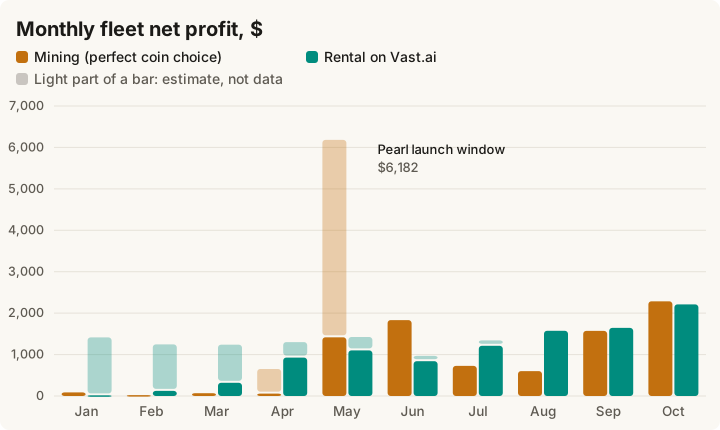
| Month | Mining, $ | Rental, $ |
|---|---|---|
| January | 88 | 1,415 |
| February | 22 | 1,245 |
| March | 67 | 1,239 |
| April | 652 | 1,301 |
| May | 6,182 | 1,424 |
| June | 1,833 | 969 |
| July | 726 | 1,343 |
| August | 602 | 1,599 |
| September | 1,571 | 1,668 |
| October | 2,285 | 2,222 |
Mining beat rental in three months out of ten. Its range is $22 to $6,182; rental's is $969 to $2,222. The June dip in rental is real, and so is the climb to October.
What drove Pearl income
In six months the network grew from 13.9 to 80.3 EH/s, the block reward fell from 2,702 to 2,199 coins, and an RTX 4090's output dropped from 14.2 coins a day in June to 4.4 in November. The price decided the rest. In August, at about $0.27, the card earned $2.5 a day; on October 21, near the peak, $12.7. Today the whole fleet on Pearl would gross about $53 a day before power; rental in October brought about $77.
Well-known projects of the year
- Pearl (PRL). Launched April 27, a Bitcoin fork with useful work in the form of matrix multiplication, capped at 2.1 billion coins. Researcher Abhinaba Basu showed that mining also works on random data, with no AI at all. By mid-October the coin traded on only two exchanges.
- Quantus (QUAN). Currently second best on the 4090 at $4.79 a day. The price fell from $152 to $72 in five weeks.
- Qubitcoin (QTC). Led on the RTX 4090 for a few days in February, now $2.65 a day.
- Quai and Conflux. Winter leaders on higher-end cards at about a dollar a day. Quai fell from $0.032 to $0.012, Conflux from $0.09 to $0.044.
- Zano. About $10.5 in May, $4.77 now.
- Kaspa. Listed first in "best coins of 2026" reviews with $1.5–3.5 per card a day. In the daily rankings over 308 days it was never the best on any of our cards. Nor were Nockchain and Aleo.
- Hashcats. A separate story with different economics: what a cat costs on an RTX 4090.
Rental by machine
| Machine | First income | Real, $ | Estimate, $ | Power, $ | Rental net, $ | Mining net, $ |
|---|---|---|---|---|---|---|
| 4 × RTX 4090 | March 19 | 6,217 | 2,072 | 532 | 7,757 | 7,003 |
| RTX 5090 | January 22 | 2,339 | 171 | 183 | 2,327 | 2,165 |
| 2 × RTX 5080 | May 28 | 1,225 | 1,119 | 224 | 2,120 | 2,437 |
| RTX 5080 | July 30 | 404 | 866 | 125 | 1,145 | 1,205 |
| RTX 3080 Ti | April 2 | 627 | 263 | 123 | 767 | 665 |
| RTX 3080 | April 16 | 549 | 284 | 116 | 717 | 576 |
| RTX 2060S | October 15 | 19 | 262 | 80 | 201 | 171 |
The VPS is not deducted here: $344 for the whole fleet. The whole account over the period, including configurations since removed from the marketplace, earned $12,534 on rental. Live figures are on the fleet page.
The weakest point of the calculation
That is the launch window, April 28 to May 24. No daily data exists for it: the tracker began counting Pearl only on May 25. We took the estimate from first-week-of-May calculators: $33.80 a day on an RTX 5090. The price in it is notional: in early May real trades ran from $0.01 to $0.35, over the counter only, and a buyer for the full volume might not exist.
| Case | Mining | Rental |
|---|---|---|
| With launch window, whole fleet from January 1 | $14,221 | $14,690 |
| Without launch window | $8,861 | $14,690 |
| Only days a machine really was on rental, with window | $12,163 | $10,141 |
| Same without window | $8,193 | $10,141 |
One assumption decides the outcome: whether in the first weeks you could mine and sell at those prices. The other assumptions favour the miner:
- The model knows the day's best coin in advance. A real miner learns it afterwards.
- It has no downtime, while our machines run at about 99% reliability, and rental already reflects that.
- Rules change overnight. The August 6 soft fork cut effective hashrate by up to 87.5% for those mining at high ranks; many found out the next morning from falling payouts.
- The SRBMiner author warned in the 3.6.8 release notes that a coming Pearl upgrade will make consumer cards "pretty much useless". If that happens, the profitability table ends in a day.
We also checked the source: we computed RTX 4090 output ourselves from Pearl network data and compared it with the tracker at five points from June to November. The gap was from zero to 10%. The tracker occasionally glitches, such as $29,929 a day on an RTX 4090: 93 such records were replaced with the median of the other cards.
Conclusion
A miner who knew everything in advance and caught the Pearl launch would have ended the year level with rental. Without those 27 days the miner falls 40% behind. Rental on these cards made comparable money without guessing a single day: its risks are load and rates, while mining's are the price, the difficulty and the rules of someone else's network.
Mining is worth keeping as an add-on. A new coin can pay dozens of times more than usual for a few weeks, but that is a window, not an operating mode. For it there is a Vast.ai background job: the card mines while no client is present and frees up within 15 seconds when one arrives. We keep rental as the main income.
Sources
- Daily rankings per card: https://www.hashrate.no/gpus/4090/historical
- Pearl network data and price: https://www.hashrate.no/coins/PRL
- Network statistics: https://miningpoolstats.stream/pearl
- First-weeks estimate: https://news.lavx.hu/article/ai-compute-coin-pearl-triggers-gpu-mining-surge-but-rtx-5090-earnings-have-already-dropped-49-percent
- First trade prices: https://lordofpearls.xyz/blog/pearl-mining-roi-2026
- The fork and the miner author's warning: https://simeononsecurity.com/articles/pearl-prl-mining-guide-2026/
- Basu's work, supply cap, exchanges: https://parameter.io/prl-token-surges-sevenfold-since-august-on-ai-mining-model-despite-code-controversy/
- Rental: Vast.ai account accruals. Calculated on November 5, 2026.
GPU market news and breakdowns — in our Telegram channel @flux_vast_news