Hashcats are pixel cats on Robinhood Chain with no "buy" button. The only way to get one is to mine it: your browser grinds hashes until one lands below the network target, you pay the entry price of the current epoch, and the contract draws the cat straight from the hash. Chats keep asking "how long does a cat take on an RTX 4090", with answers from "a couple of hours" to "three days". We pulled live numbers from the project site, measured the network pace and did the math. Short answer: the card is not the bottleneck.
What Hashcats is
One ERC-721 contract on Robinhood Chain (chain id 4663). The image, traits and palette live in contract storage: tokenURI builds the PNG on the fly, so the collection survives the site disappearing. There are 16,376 cats "to the wall"; past it the work grows quadratically, and the authors' simulation stops the collection at 17–20 thousand. As of 12 September 2026, 5,604 cats have been mined and epoch nine is running.
What the card actually computes
The miner takes four values and computes Keccak-256 over them — the same hash Ethereum uses:
- your address — so nobody can steal a solution: for another address the hash is different;
- the nonce — the only free number, this is what gets ground;
- the work behind the previous cat — so nothing can be mined ahead of time, and the moment somebody else mints, every ticket you found is dead;
- the anchor — the hash of a recent L2 block, valid for about 25 seconds.
A hash strictly below the target is a ticket. The contract checks it with one comparison, takes the entry price and mints the cat. No queue, no auction: whoever sends first gets the cat.
Difficulty: the floor, the streak and the wall
Difficulty here is not one number but several rules, each closing a different way of getting a cat cheaply:
- epoch floor: 26 bits plus the epoch number, 35 bits right now; every epoch is twice as long as the previous one, and at its border the floor rises by a bit;
- retarget every 8 mints: the contract compares the real pace with the "one cat per 10 seconds" plan — up to 4× harder per step, at most 2× easier, never below the floor;
- streak: every recent mint doubles the work and cools one step per 10 seconds; twelve cats in a row cost 4,096 times the work of one;
- the wall after 16,376: the work is multiplied by (number − 16,376)² / 200.
While the network mines without pauses, the streak sits at 7–10 steps and the real target stays at 42–45 bits. In hashes that is 4.4 to 35 trillion per cat.
What an RTX 4090 can do
An important correction first. The "MD5 163 GH/s, SHA-256 22 GH/s" figures quoted in chats come from the benchmark of hashcat, the password cracker. It is a different program with a similar name. Hashcats computes Keccak-256, and on that hash an RTX 4090 does about 5 GH/s in the same hashcat:
| Algorithm | RTX 4090, hashcat v6.2.6 | Relation to Hashcats |
|---|---|---|
| MD5 | 164.1 GH/s | not used |
| SHA-256 | 22.0 GH/s | not used |
| Keccak-256 | 5.06 GH/s | exactly this hash |
The second nuance is where you compute. The browser miner on the project site runs through WebGPU; the authors quote 250 MH/s for a 2016 GTX 1050 Ti and add that a current card does far more. There are no public browser measurements for a 4090; a rough extrapolation gives 2–4 GH/s. There is a CUDA miner on GitHub (asbryx/hashcats-cuda-miner): its authors measured 6.3–6.6 GH/s per card on an RTX 5090, so a 4090 in CUDA should be around 4–5.
How long a cat takes
Expected time is hashes per cat divided by card speed. At 5 GH/s in CUDA and 2.5 GH/s in the browser:
| Network target | Hashes per cat | 4090, CUDA | 4090, browser |
|---|---|---|---|
| 42 bits | 4.4 trillion | 15 min | 30 min |
| 43 bits | 8.8 trillion | 30 min | 1 h |
| 44 bits | 17.6 trillion | 1 h | 2 h |
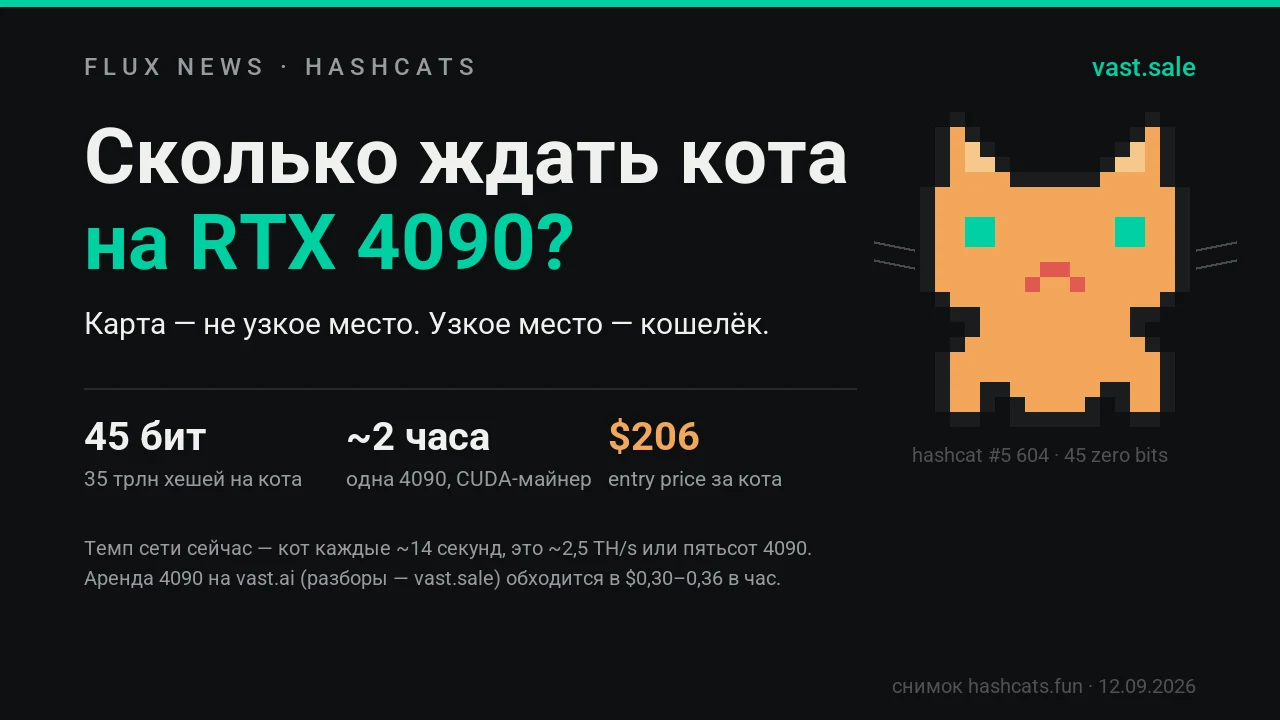
| 45 bits | 35 trillion | 2 h | 4 h |
| 46 bits | 70 trillion | 4 h | 8 h |
This is an expectation, not a guarantee: mining is probabilistic, a cat may come in five minutes or in six hours. But the "several hours to 1–2 days" range circulating in chats is pessimistic for a 4090 today — that is 3060 territory, not 4090.
We measured the network pace directly: 9 cats in 129 seconds, i.e. one cat every 14 seconds at 45 bits. That is about 2.5 TH/s — the equivalent of five hundred RTX 4090s is sitting in the network right now, and almost all of them are farms. What will push the numbers up: in 2,601 cats epoch 10 begins, the floor rises by a bit and every wait doubles; new farms arriving raise the retarget; past the wall at 16,376 the work grows quadratically.
Where the real money is
The card is not the bottleneck. Renting an RTX 4090 on vast.ai (write-ups and a live fleet showcase — vast.sale) costs $0.30–0.36 per hour: ten cents to a dollar per cat. Then comes the part the "how long" question never mentions:
- the entry price is 0.0818 ETH right now — about $206 at the 11 September rate ($2,514 per ETH); it equals the number of cats already in existence × 0.00002 ETH and doubles at the epoch border;
- the collection floor on OpenSea is 0.081 ETH: you will not flip a fresh cat at a profit;
- 70% of every later mint goes to earlier cats as rent — 0.000014 ETH per mint per cat; to the wall that is about 8,000 more paying mints, or 0.11–0.15 ETH (~$290–380) per cat;
- the other exit is burning the cat for 1,000 $HASH in its own epoch, with the rate halving every epoch after.
In practice: how to check, and how to mine on a rented card
The most honest way to learn your time is to run the card for 5–10 minutes and read two numbers in the miner: Speed and Expected wait. Everything else is math on paper.
- in the browser: hashcats.fun/mine, the CPU → GPU switch appears if your browser supports WebGPU;
- on a rented card: the CUDA miner with the coordinator at home — the wallet key signs transactions locally, only work goes to the remote machine;
- never put the wallet key on a rented host — not in a config, not in environment variables;
- do the economics from the entry price, not the rent: an hour of the card costs less than the gas of one transaction.
Need a 4090 for the miner or your own rig on vast.ai — https://vast.sale/services ; live fleet income per machine — https://vast.sale/fleet .
Sources
- https://hashcats.fun — mechanics, live difficulty and network pace (snapshot 12.09.2026, 17:53–17:55 MSK)
- https://github.com/asbryx/hashcats-cuda-miner — CUDA miner, RTX 5090 measurements
- https://gist.github.com/Chick3nman/32e662a5bb63bc4f51b847bb422222fd — hashcat v6.2.6 on RTX 4090
- https://opensea.io/collection/hash-cats — collection floor
- https://fortune.com/article/price-of-ethereum-09-08-2026/ — ETH rate on 11.09.2026